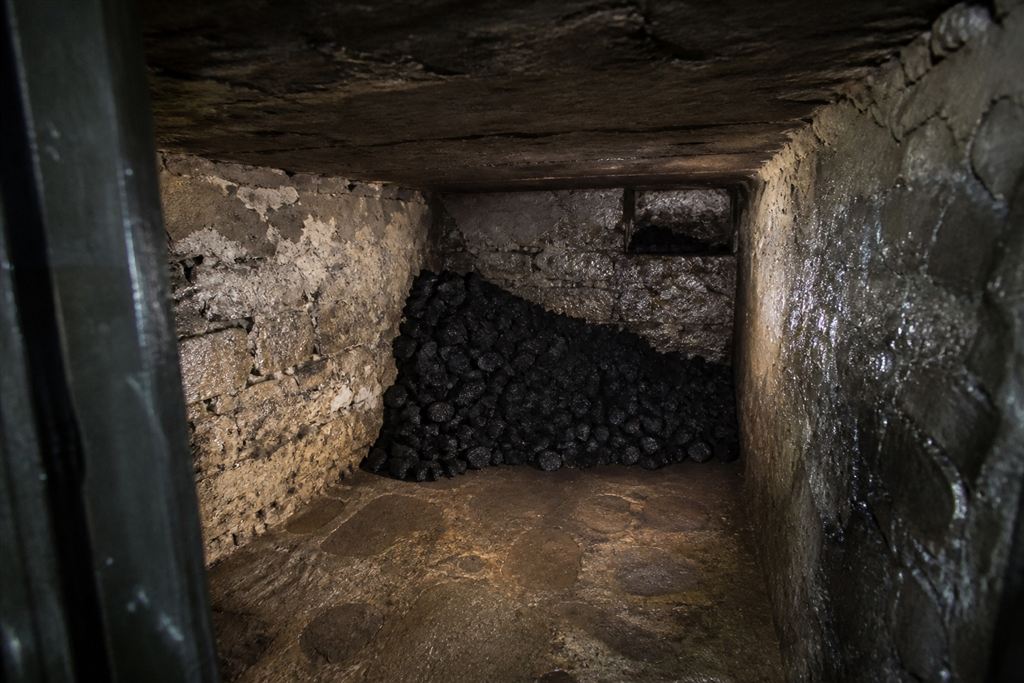
First response (the wet day)
If the cellar is in water now:
- Electricity — mill-terrace coal cellars often have a meter, a fused spur, or a later socket on a damp wall. If water is near any of that, treat the room as unsafe. We are not an emergency electrician.
- Stop adding water — a washing machine discharging into the cellar, a burst in the kitchen above the front-room stair, a yard gully emptying at the only exterior wall. Plumbing leaks are not Type C. A hopper on a Parkwood rear yard (where a terrace even has one) is not valley groundwater.
- Pump-out — a wet vac may empty a metre-square coal hole. A tanker on West Lane, Lawkholme Lane or Highfield is mill-street parking, not a drive: say so if you think you need one. Back-to-backs have no rear elevation to park against.
- Do not hack off plaster as a panic move, and do not paint slurry onto wet millstone or the shared rear wall “to seal it”. Barrier coats on this stock fail at the party wall and at the one weather elevation.
- Photograph the high-water mark on both party walls and on the rear wall if it is a back-to-back. That mark is evidence for whose water it might be, not only how deep it was.
Keighley Cellar Waterproofing is not a 24/7 flood-restoration franchise. If you need a same-day pump-out, say so on the phone. The waterproofing specification still waits until we can see the empty room. A first-visit pump-out is a different, smaller ticket from a Type C install — see cost bands.
What “flooded” usually means on this stock
The River Worth runs through Ingrow and Worth Village, past the town, and meets the Aire at Stockbridge. The Leeds–Liverpool Canal sits on that same valley floor. After rain, cellar water here is usually one of four patterns — and the survey is there to tell them apart, because a Morley-style drain jet and a slurry tin both guess wrong:
- Valley-bottom groundwater at Stockbridge, Eastwood, Beechcliffe and the lower Worth — water that was already in the ground before it found the slab. Standing water, not a tide-mark film.
- Mill-era combined drain surcharge under a West Lane / Parkwood / Highfield terrace. After rain the street pipe is full; the cellar invert is lower than the pipe; water comes back up. Jetting the gully without measuring invert will look busy and miss the job.
- Rain through millstone and failed pointing on Ingrow / Worth Village stone — lime joints, not a suburban land drain under a lawn.
- Seepage on the shared rear wall of a Lawkholme or Highfield back-to-back — water that may have started in the house behind, in the shared masonry, or under both houses at once.
It is not clay perched on a Meanwood hillside. It is not Ilkley Moor runoff on a stepped villa. It is also not Bingley’s Five Rise / canal-side mix with suburban edges at Crossflatts. A specification written for those towns will misread this flood.
Later houses at Utley, Guardhouse and the Bracken Bank estates often have no traditional cellar. If the “flood” is a ground-floor slab, say so on the form; we will not invent a coal-cellar Type C job.
Riddlesden and Thwaites, immediately adjoining on the Aire, are in play when the house is actually that stock. They are not a Bradford city dump.
If every wet week repeats the same puddle on the same slab, first response is not enough. That is the Type C conversation: tanking a cellar in a mill terrace (what we actually install), Type C cavity drain, plain English.
Whose water is it, on a back-to-back?
On a Lawkholme or Highfield back-to-back the rear wall of your cellar is the neighbour’s cellar wall. Floodwater you see may have started:
- in their room (their hatch, their gully, their burst)
- in the shared masonry
- in the valley under both houses
A first-response pump-out of *your* coal hole does not dry *their* side, and a slurry coat on your face of that wall will not. The discovery survey asks about the house behind before anyone cuts a channel. Party Wall etc. Act 1996 notice may be needed before works, not before you photograph a tide mark.
We do not waterproof their cellar from your front-room stair.
Full waterproofing is the second job
A flooded cellar that dries and never returns may only have needed a drain repair, a hopper, or a one-off burst above. A flooded cellar that returns on the Worth / Aire valley floor, or through a shared rear wall every wet week, is a candidate for cavity drain and a sump — if the floor plate is big enough for a chamber at all. Some coal holes are not. The survey is allowed to say “do not do this job”.
The discovery survey is booked once you can get into the room through the front room. Cost sits on the cost page as ranges, not a flood-day guess. A coal hole is not automatically a £10k–£30k Type C job; a used cellar taking valley groundwater often is.
Conversion talk waits until it is dry, and even then that page stays short — quoted "cellar conversion" Keighley is already milled. After waterproofing. Every button still books the waterproofing survey.
FAQs
Is a flooded Keighley cellar the river coming in?
Sometimes the water table is the Worth or the Aire — especially at Stockbridge, Eastwood and lower Worth Village. That is groundwater, not a river coming through the front door. Canal overtopping is a different, rarer story and not the default on West Lane. The survey asks which street before anyone talks “floodplain”.
How do I tell valley groundwater from a mill-era drain that is already full?
You probably cannot from the top of the front-room stair. Standing water after every wet week on a Stockbridge slab, with no sewage smell, leans groundwater. Water that arrives with a gurgle at the gully, or with a smell, leans surcharge. Both happen on this stock. A visit that only jets the drain, or only sells slurry, will miss one of them.
The house behind is wet too — is that my flood?
On a back-to-back, maybe. Photograph both sides of the story if you can talk to them; do not assume their wet is your job or yours is theirs. Party Wall comes later. First response is still: electricity, stop adding water, photograph the rear-wall mark.
Will you come out the same day as the flood?
Phone 01535 920438. Capacity depends on the eventual operator. Mill-street access and a hatch through the front room are slower than a suburban coal chute. Do not advertise 24/7 emergency plumber cover we cannot keep.
Should I run a dehumidifier in a West Lane coal hole and wait?
After a one-off plumbing leak, sometimes. After repeated standing water on a valley-bottom slab, a dehumidifier hides the smell and does not fix invert, surcharge, or the shared rear wall. It also will not make a metre-square cupboard into a dry room.
Can you tank it while it is still wet?
No. Barrier coats on wet millstone and on a shared back-to-back wall are how this stock already fails. Type C is specified on an empty room after the first visit. Cellar tanking vs Type C.
Do you cover a flooded cellar in Bradford, Haworth or Bingley from this page?
No. This domain is Keighley. A Bradford city dump is doorway-shaped. Haworth up the Worth is not harvested here. Bingley is a different cell (river/canal mix, not this mill-terrace pack).