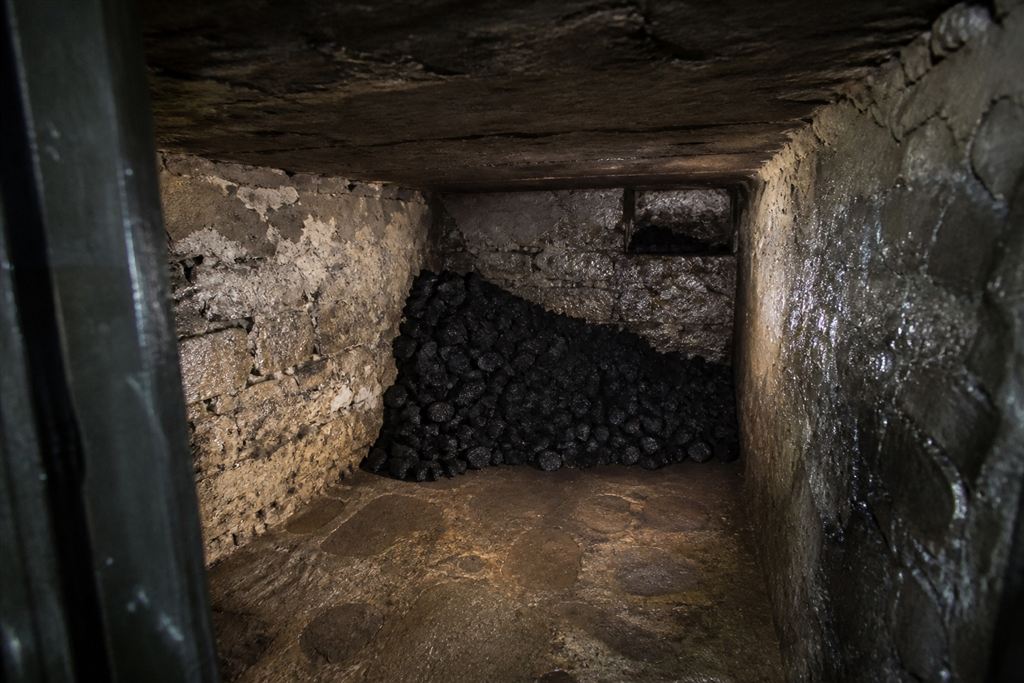
What “tanking a cellar” means on this stock
The phrase is a mess in mill-terrace English. It is not painting millstone grey. It is not a membrane roll hoped against the shared rear of a Lawkholme back-to-back. It is not a 1930s Alwoodley utility with a garden and a chute.
It is a decision about Worth / Aire valley water, and rain through mill-era stone, managed inside a room you can only reach through the front room.
Three facts about this town:
- The hole is tiny. West Lane coal cellars took sacks from the mill. Some cannot take a sump body at all.
- Two or three walls are shared. Terrace both-sides is normal. Back-to-backs add a rear neighbour. A coat on those walls is a bet on houses you do not own. A drained cavity only needs *your* face of the masonry.
- In through the living room. Often no rear yard, no chute onto a lawn, no side passage. External excavation is not plan A because there is nothing to excavate. Bradford district Building Control signs it off — not Leeds.
What actually gets installed through a West Lane hatch
Kit does not come off a van into a garden. On a mill terrace it comes through the front room, down a hatch or a tight stair, into a coal hole that may have only one weather wall.
The survey day on West Lane / Lawkholme is a record of things a suburban chute job never asks: moisture map; invert of the mill-era combined drain toward the Worth; thickness of the shared rear (back-to-back) or both party walls (through-terrace); whether a sump body will even pass the front-room opening. That record is the discovery survey.
Strip-out is local, not theatrical. Failed slurry and loose bitumen and rotten linings come out of *this* cellar. Sound millstone or brick stays. We do not empty a Worth Village coal hole to a shell because a national guide said so, and we cannot “hack off the whole row”.
The drained lining is then built for a one-wall problem: perimeter channel at the floor joint, falling to a sump (short on a Highfield one-room; longer on Ingrow stone, with the invert toward the Worth doing more of the work); cavity-drain membrane on every face we can reach, including the shared rear; water from valley groundwater or a failed combined drain running in the dimpled gap. The packaged pump discharges to whatever combined drain already serves this house (where the water goes, and whether the row will hear it). There is often no rear yard to hide a run.
Notices sit with City of Bradford Metropolitan District Council Building Control. Keighley is Bradford district. It is not a Leeds application with the town name swapped.
People still type “tanking a cellar”. On a hatch-access back-to-back that phrase means the Type C cavity drain described above, not a slurry on the only weather elevation.
When the coal hole is not a £10k ticket
Utley and Guardhouse later houses with a dry meter cupboard are not a tanking job. A Bracken Bank plot with no cellar is not a tanking job. A kitchen leak is a plumber. A coal hole that is unused, dry, and smaller than the sump body is a conversation about leaving it alone — which this cell is allowed to have, because quoted conversion search in Keighley is already milled and we are not here to force a lining.
The survey’s job is to refuse the wrong ticket, not to upsell a chamber into a cupboard. Where a used cellar is taking Worth / Aire groundwater, full Type C commonly sits £10k–£30k (course rule: typically above £4k or we say no). Where it is not, we say not. What changes the price.
Sister URL: cellar tanking
Cellar tanking as a search is the sister page: coats already on mill-terrace walls, especially a previous “tanking” on a back-to-back rear, versus the drained lining we specify through the hatch. Different URL, different copy. Cellar tanking vs Type C in a Keighley back-to-back
We name tanking membrane because the national product queries are large . On this domain it is a line in a Worth-invert spec, not a SKU. We are not preservationshop.co.uk.
Conversion stays a short upsell
Quoted "cellar conversion" Keighley is already milled, so this cell keeps conversion as a short upsell. If you later want a usable store, mention it on the hatch survey so laps and the chamber are not wasted. Dry first. Cellar conversion in Keighley (after waterproofing) Every button still books waterproofing, not a design quote.
FAQs
Does tanking a cellar in a West Lane terrace mean covering every wall in cement?
No. A cement coat on a West Lane party-wall coal hole fails where the terrace has settled and, on a back-to-back, at the one weather elevation. We specify a drained lining unless the hatch survey finds a dry cupboard that should not be forced.
Can you tank from the outside so we keep the cellar empty of membrane?
External tanking means excavating the plot. On West Lane, Parkwood and Lawkholme there is often no plot: the front door opens onto the pavement, and a back-to-back has no rear elevation. Internal Type C is not a preference here. It is the only honest method the stock was built for.
Will Bradford Building Control treat “tanking a cellar” as DIY?
Not if it changes structure or below-ground drainage. Keighley jobs sit with City of Bradford Metropolitan District Council, not Leeds City Council. The discovery survey is the record for that notice.
How long does tanking last in a Keighley back-to-back?
With one weather elevation and groundwater pushing from the Worth and Aire side, the membrane and channel are the long-life part and the pump is the wear item. Budget for a pump service every year or two and the lining itself is a decades-long job — the failure we get called to is always a neglected sump, not the membrane.