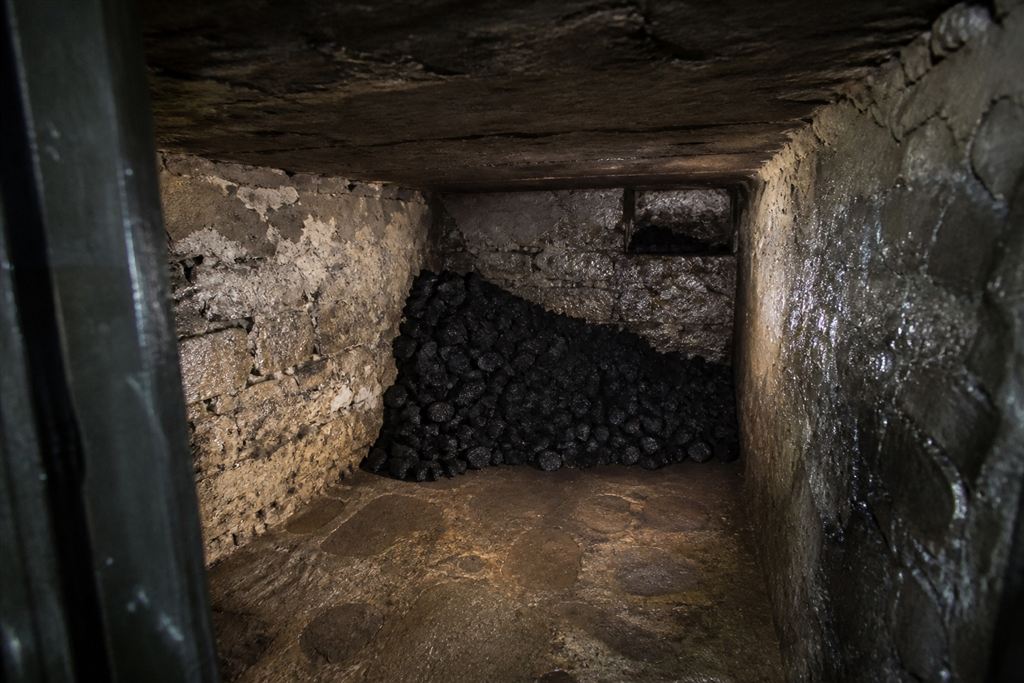
BS 8102 in the language of a mill-terrace coal cellar
Ask a specifier about BS 8102 and you get Types A, B and C. Ask a West Lane homeowner standing on a hatch and you need the same three ideas in mill-terrace English:
Type A tries to seal mill-terrace stone with a slurry, a sheet or a coat. That only holds if the wall never cracks and the shared rear of the back-to-back never weeps. Stone sitting in Worth / Aire groundwater, with two neighbours and sometimes a third behind, is a poor candidate.
Type B wants the structure itself to be the tank. Victorian mill housing was not poured as waterproof concrete. There is no Type B box under West Lane.
Type C accepts valley water — Worth at Ingrow, Aire at Stockbridge — wetting the outside, and the house behind wetting the shared rear. Catch it on your face of the wall and take it away. You do not need four exterior walls.
A Parkwood hatch is enough of a classroom. bs8102 is the query; the survey is the spec.
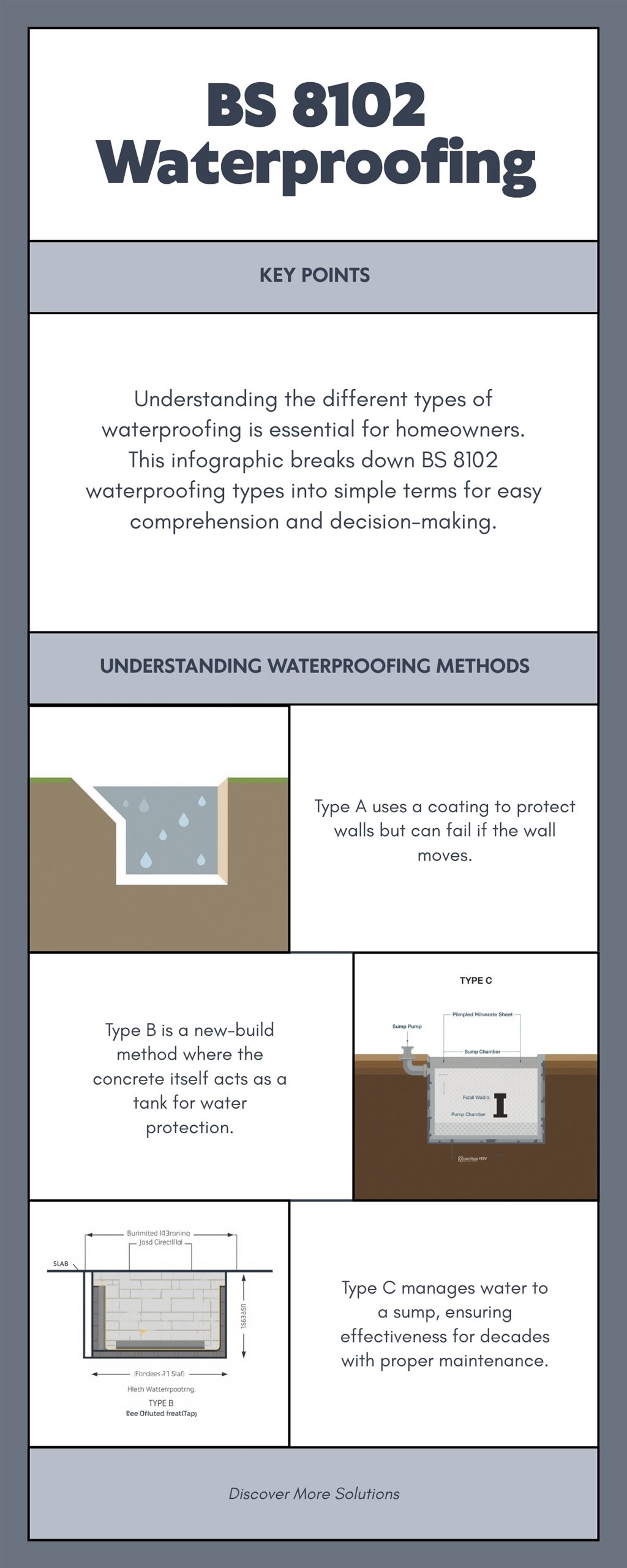
Diagram — BS 8102 types in plain English. Illustrative, not a site photo.
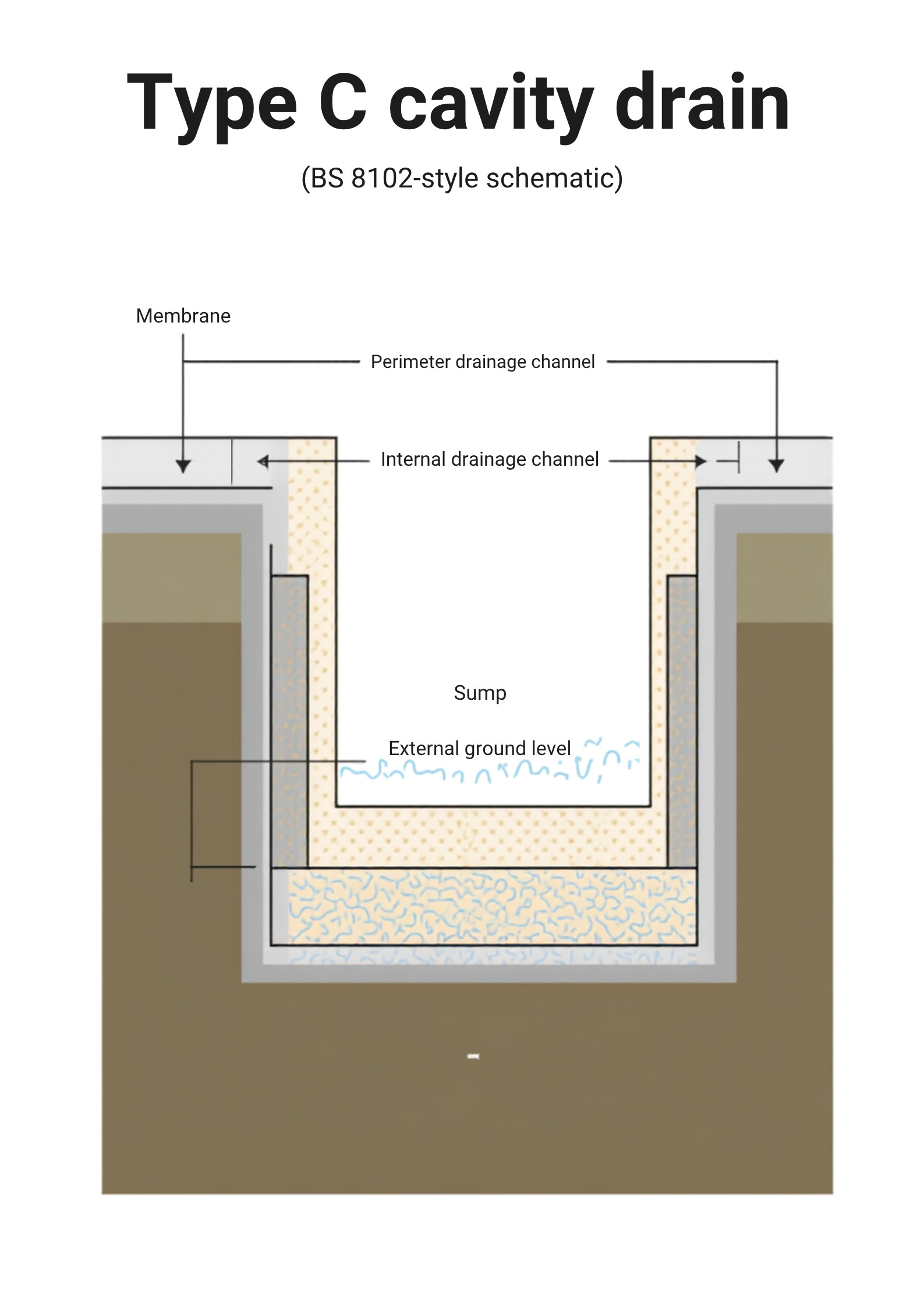
Diagram — how a Type C cavity drain system works. Illustrative, not a site photo.
Where a sump can discharge on this plot type
Keighley plots are smaller than an Alwoodley front garden. Many have no plot at all.
- Existing combined drain — the usual outfall on a mill terrace. The survey finds the invert. Mill-era drains at Stockbridge and Eastwood already surcharge after rain; pumping into a full pipe is a different problem from pumping into a clear one.
- No front garden to hide a trench. West Lane and Lawkholme Lane open onto the pavement. We do not invent a lawn run.
- Back-to-back: no rear yard. Discharge cannot sneak out the back. The run has to follow whatever drain already serves this house, through the only elevation that exists.
- Ingrow / Worth Village stone — slightly more space on some plots, still Worth-side invert, still Bradford combined, still not a hillside light-well like Ilkley.
- Later Utley / Guardhouse / Bracken Bank — many have no cellar; if they do, later plastic drainage may already be shallow. Record it; do not assume an 1880 invert.
Noise, lid, and the house behind: Sump pumps in Keighley cellars
Cellar waterproofing systems, without the catalogue
A Type C system on this stock is membrane + channel + sump + pump + a legal outfall + a maintenance path to the lid in a room you can barely turn round in. It is not a brand name. It is not three competing product families listed as if we were a merchant.
Waterproofing cellar walls with Type C still leaves the original stone in place. That matters on a back-to-back: we are not rebuilding the neighbour’s rear wall.
Tanking a cellar — what we actually install Cellar tanking vs Type C Cost variables, including when the coal hole is not £10k
FAQs
Is Type C overkill for a one-room West Lane coal cellar?
Not if that room floods or stays wet and you use it. Overkill is a full system in a dry meter cupboard at Utley. The survey is the filter. Ticket for a real Type C job is not a few hundred pounds; a coal hole that cannot take a chamber is also not a forced install.
Do we need Type C if we only get water after the Worth is up?
Rain-after-valley-rise is exactly the Stockbridge / Ingrow / Worth Village pattern. A drain repair might be part of the answer; a slurry coat on the inside is usually not. Type C manages what still arrives through stone and shared walls. The survey says which. Flooded cellar
Will a cavity drain membrane make the cellar smaller?
The dimpled sheet takes millimetres, not feet. On a coal hole every millimetre is noticeable, which is why the survey measures headroom and the front-room opening before anyone promises a future store. Conversion in this town is a short upsell, not a design quote.
Can Type C work if three walls are shared?
Yes. The membrane is on your face of those walls. Water in the masonry still has a path to the channel. What Type C cannot do is dry the neighbour’s cellar from your side — that is a different house and a Party Wall conversation.